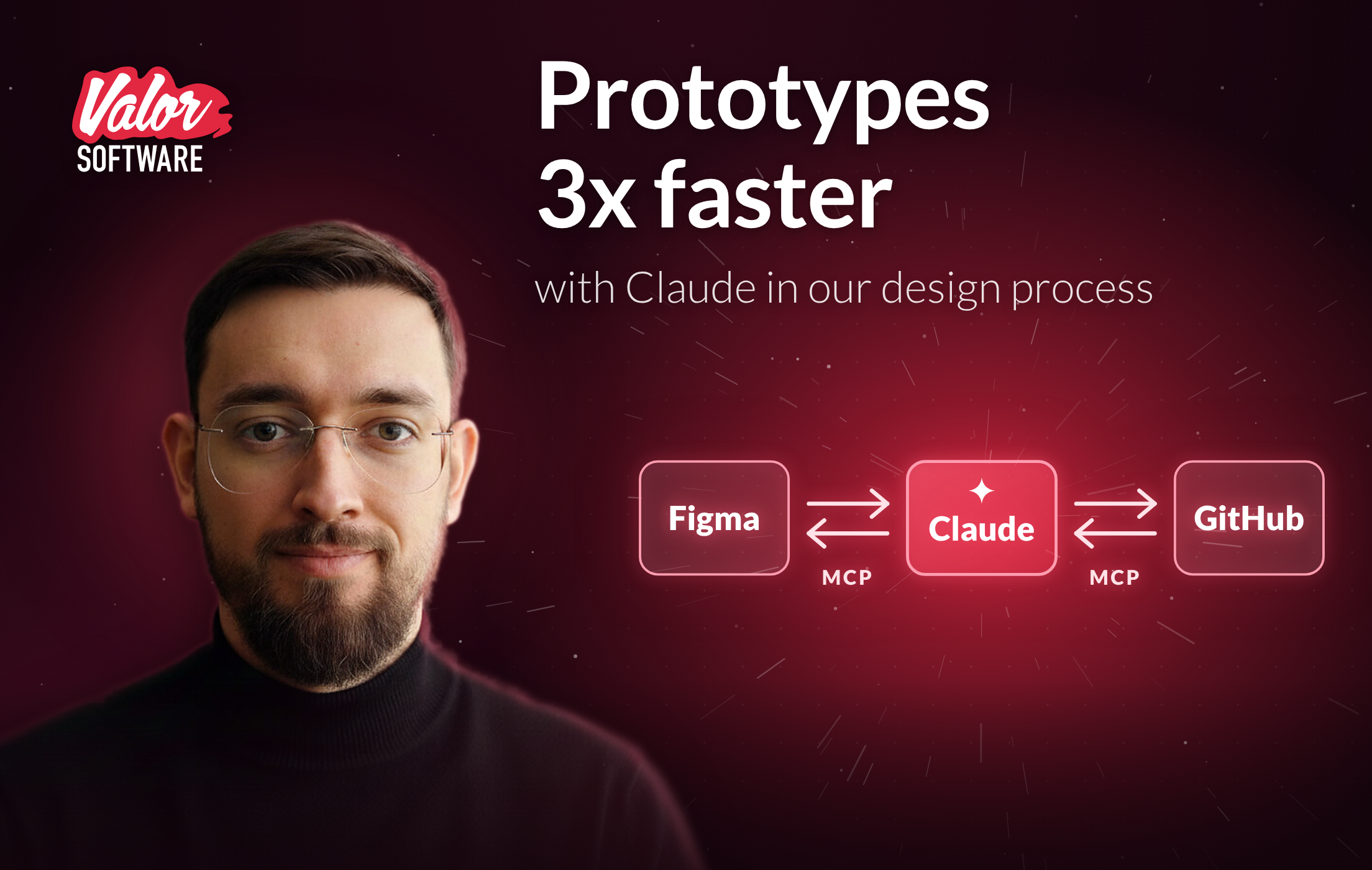
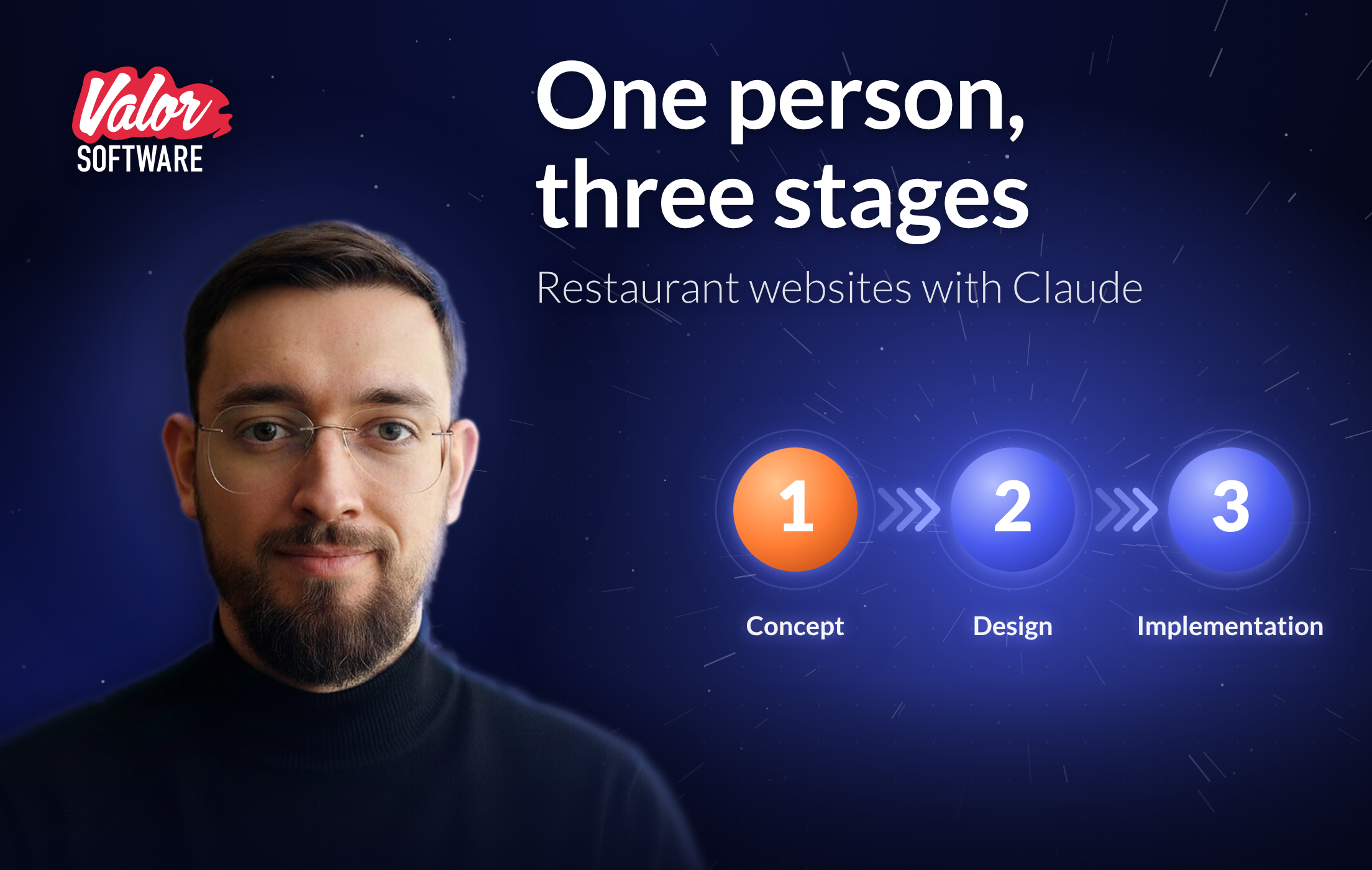
How Valor Software moved small booking-and-delivery sites from a four-person team to one person working with Claude, Figma and Webflow
Some of the projects that come to Valor Software are small and very concrete. A restaurant wants a site where guests can book a table and order delivery. A shop wants a catalogue with pickup and gift cards. A venue wants events, private hire and a map that works on a phone.
This article is about one question: how do you build these sites faster, with far fewer meetings, and still give the client something they love? Here is the problem we had, how it looks now, what we changed, and what we got out of it.
The problem
These sites are simple, but we used to run them like big projects. A project manager, a designer, a front-end developer and a QA engineer, plus the client. Every time work moved from one person to the next, there was a handoff, and almost every handoff came with a meeting. Someone retold the brief. Someone waited for a review slot. Someone rebuilt in code what had already been drawn.
That is the hidden cost of a relay, and it is well documented. Fred Brooks showed it back in 1975: the number of communication paths grows as n(n−1)/2, so a group of five has ten of them and a group of two has just one. Microsoft’s Work Trend Index surveyed 31,000 people in 31 countries and found that inefficient meetings are the top complaint about work. 56% of people could not summarise what their last meeting was about, and 68% said they lack uninterrupted time to do the job.
For us it meant six to eight weeks for a site the owner could picture in an afternoon.
Before and after
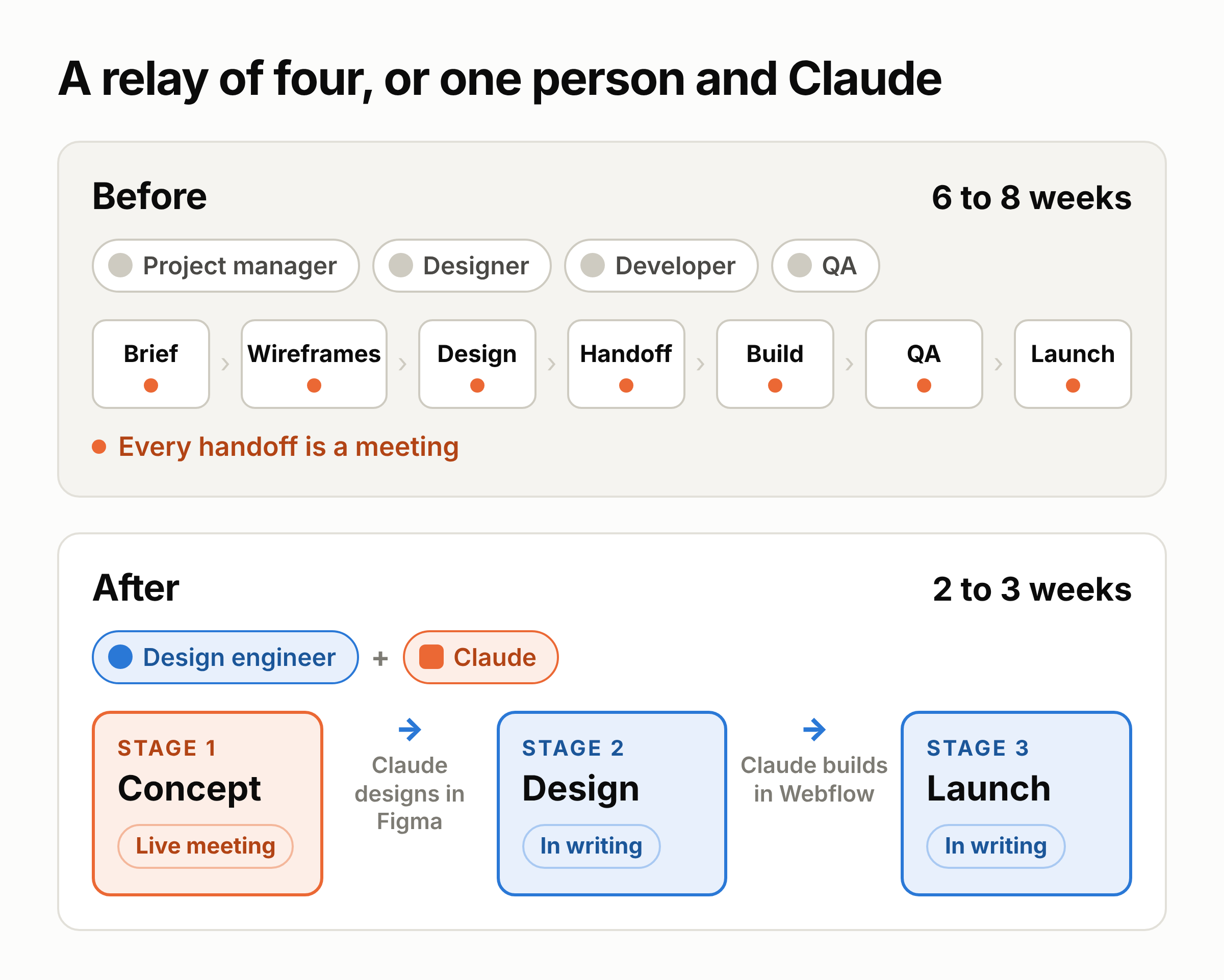
Before, four people passed the work along a chain. Now one person, a design engineer, works together with Claude, and the whole project runs in three stages with a single live meeting.
Who is a design engineer
The role is not new, and it did not start with AI. Vercel’s design engineering team describes it as people who "blend aesthetic sensibility with technical skills," moving "from owning a specific part of the product development process to owning results." One field guide puts the effect simply: with a design engineer in the seat, the handoff stops being a handoff, because the person who decided how it should look is the one making it look that way.
In our projects the design engineer designs the site, builds it, connects the booking and ordering services, and tunes it after launch.
What AI changed is the cost. A design engineer used to be a senior generalist you could only afford on big projects. With Claude carrying much of the routine work, the role makes sense even on a restaurant site with a four-week budget. Figma’s 2025 AI report, a survey of 2,500 designers and developers, found that 78% said AI made them more efficient and 58% said it improved the quality of their work.
What we did: three stages
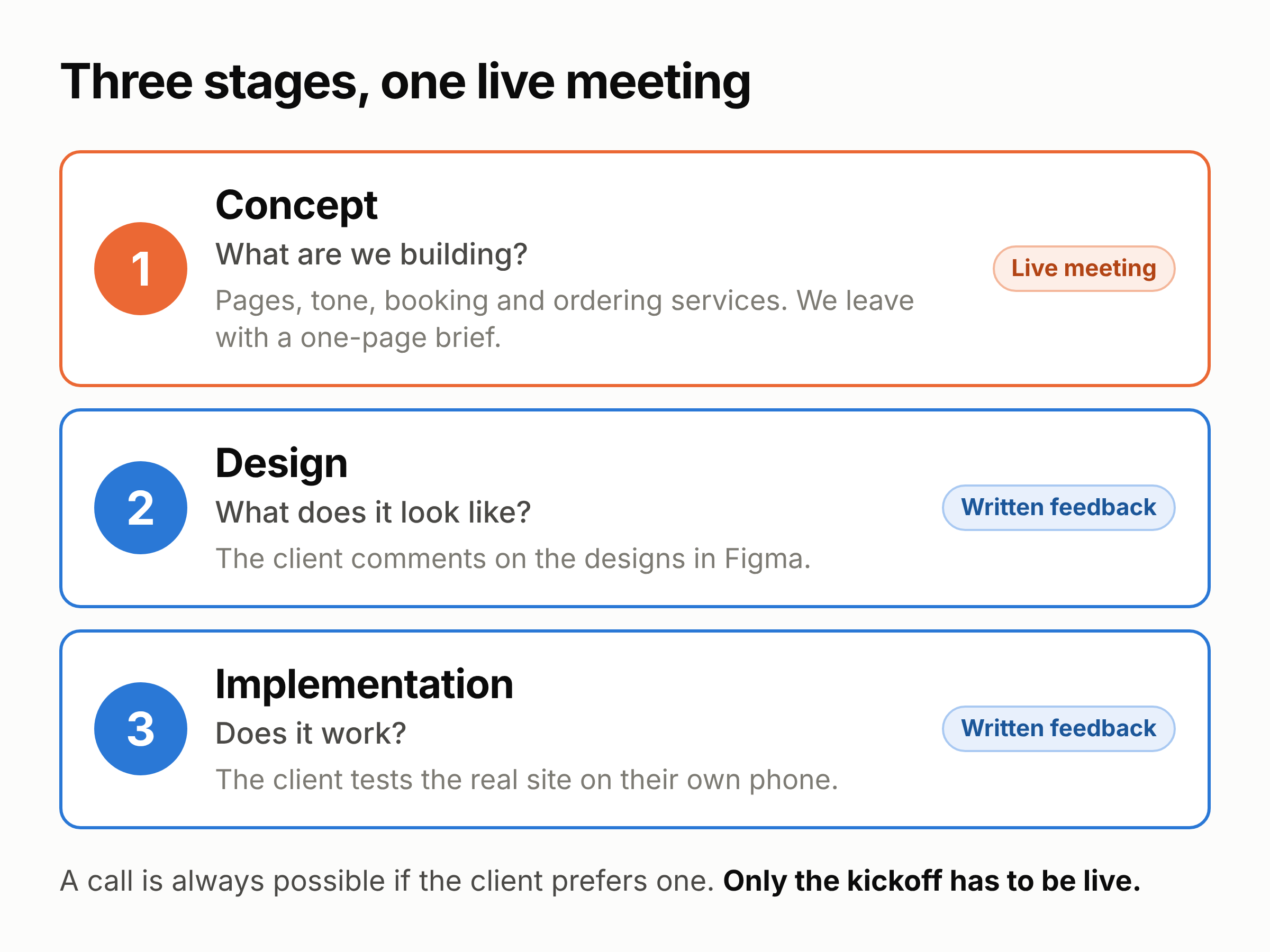
Each stage answers one question.
Stage 1, Concept: what are we building? This is the one live meeting, and we never skip it. In about an hour we agree on the pages, the tone, and which booking and ordering services the business already uses. We leave with a one-page brief that Claude can read. Everything after this is built from that brief, so it is worth a real conversation.
Stage 2, Design: what does it look like? Claude turns the brief into designs in Figma, and the client gets a link. They open it on their phone, because that is where most bookings come from, and leave comments right on the designs. One or two rounds, usually within three days.
Stage 3, Implementation: does it work? The site is ready on a test address. The client books a table and orders a dish on their own phone, then tells us what arrived. A short screen recording shows how to edit the menu. One round of feedback, and we have a launch date.
We call these stages on purpose. Stages two and three do not need a calendar slot, and a quick call is always possible if the client prefers to talk. What we do not skip is the kickoff, because a vague brief makes every later stage vague.
How Claude fits in
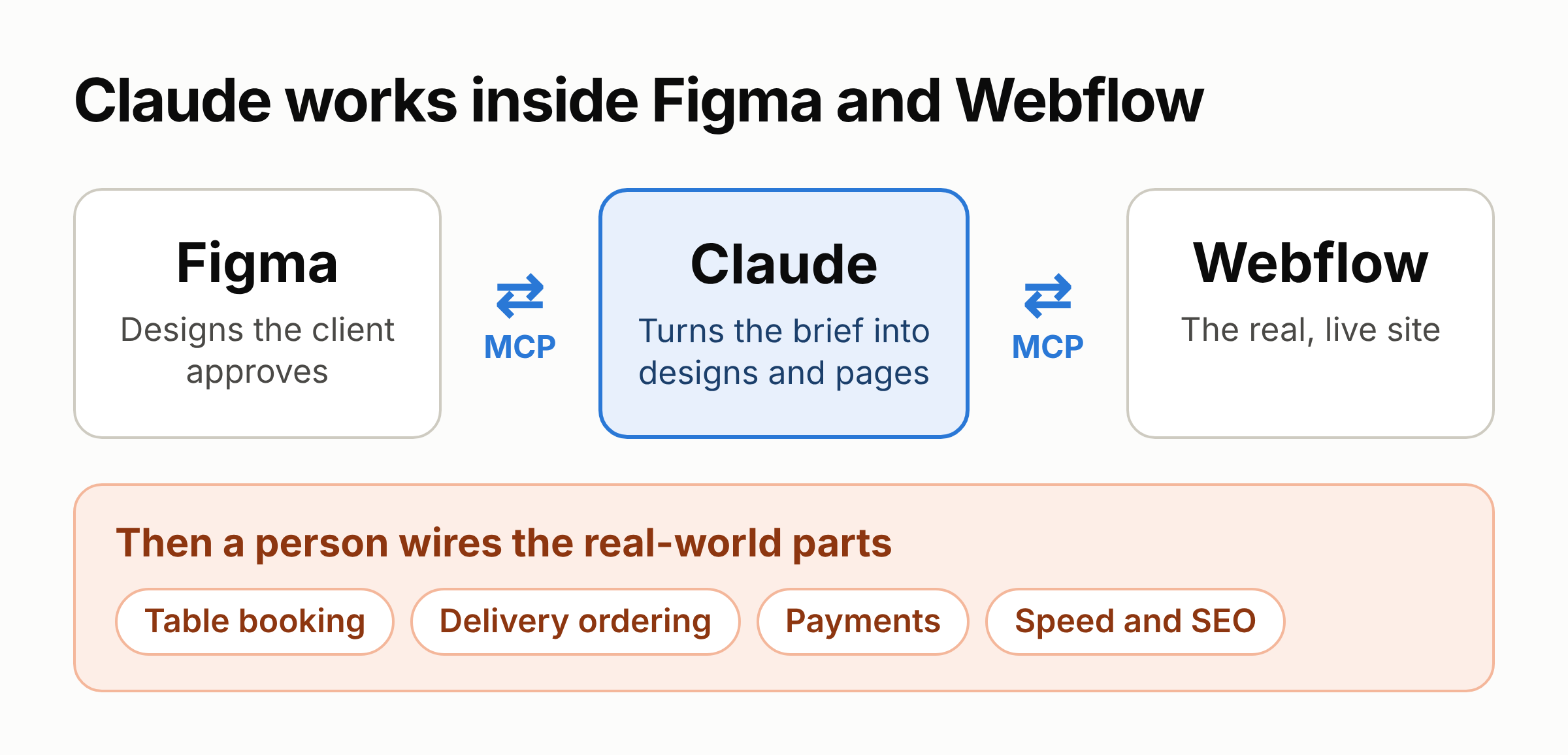
Claude works directly inside the tools through a standard connection called MCP. The Figma connection reads a small style kit we prepare for each project and writes the finished designs onto the canvas. Figma’s documentation lists which apps support it, and Claude Code and Claude Desktop are on the list.
The Webflow connection does the same for the build. Webflow’s developer documentation says it can create pages, edit elements, manage styles, build components and manage CMS collections, all inside the user’s existing permissions. A few actions need the Webflow Designer open with its helper app connected, which is how we work anyway.
The real-world parts are still wired by a person: table booking, delivery ordering, payments, maps, speed and analytics. Every provider has its own quirks and its own idea of what a "reservation" is. Claude drafts the code and explains the provider’s documentation. It never gets the keys, and it does not test on the client’s phone.
One brief, two results
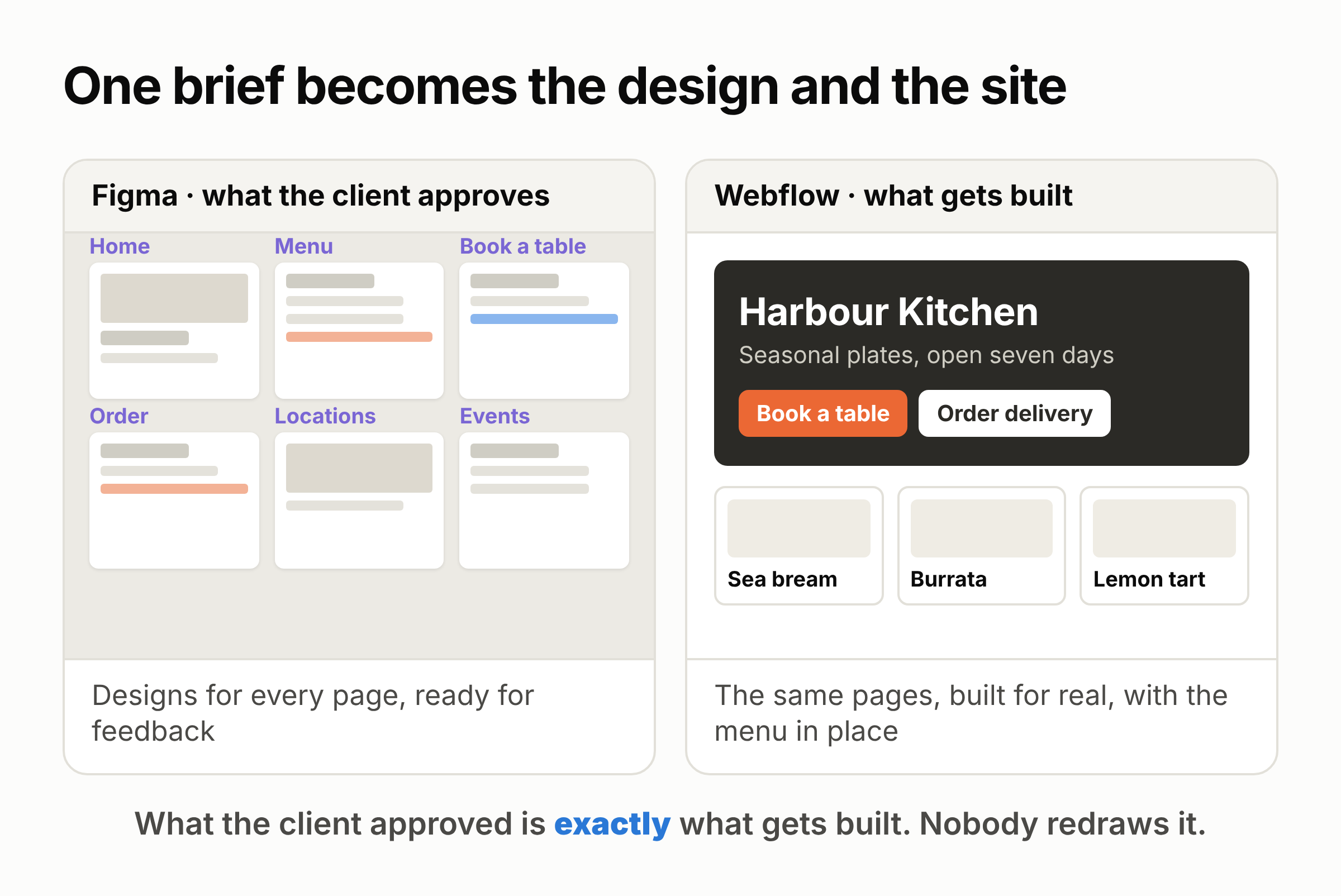
The same brief ends up in two places. In Figma it becomes the designs the client approves. In Webflow it becomes real pages with tidy styles and a menu already loaded into the CMS. Because both come from one source, what the client signed off is exactly what gets built. Nobody redraws it and nobody rebuilds it.
That is why Figma stays in the process, even though we could generate Webflow pages straight from the brief. The client needs something visual to approve, and the designs become the record of what was agreed when a change request arrives three months later.
Where one person is enough, and where it is not
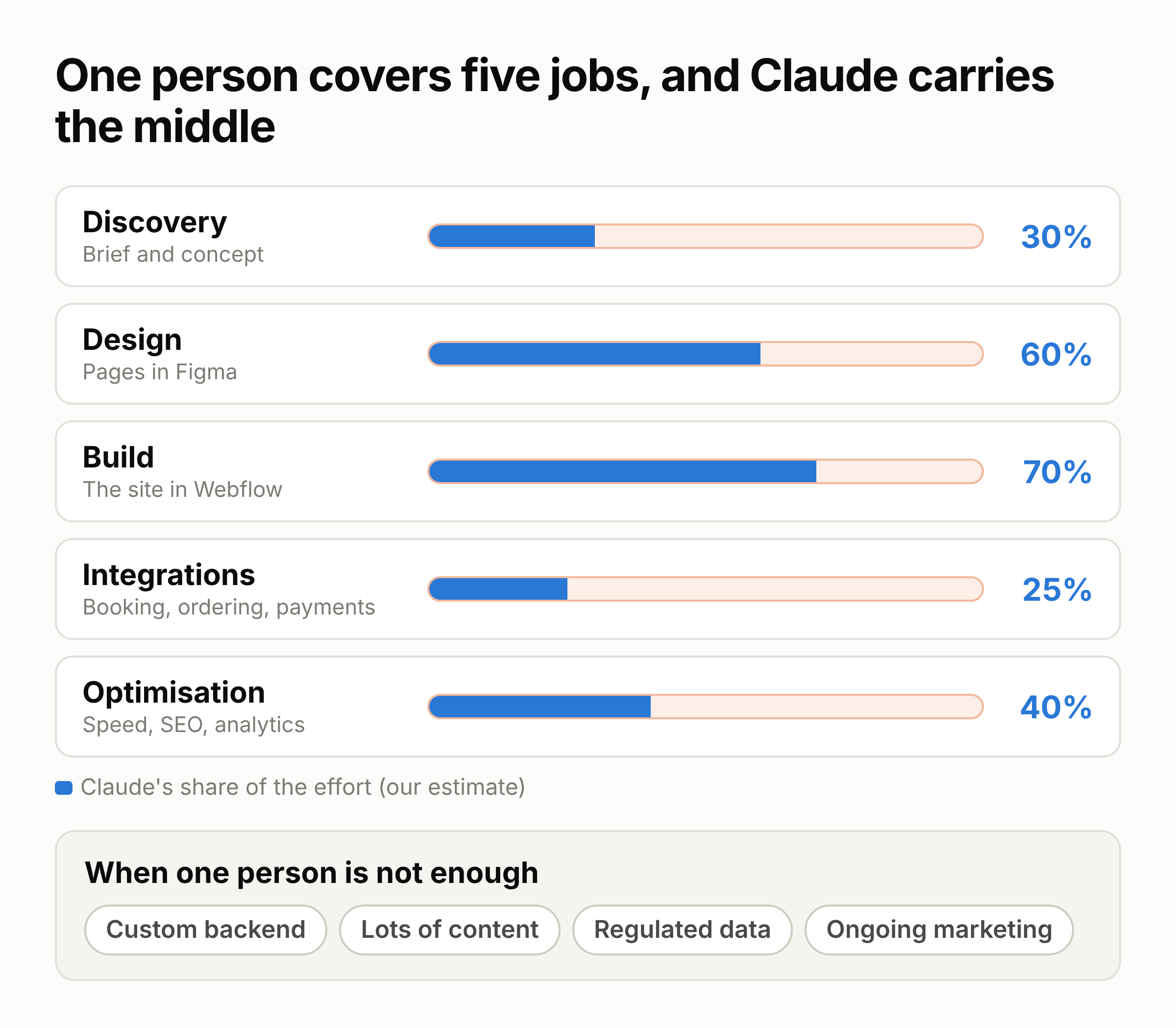
The design engineer covers five jobs: discovery, design, build, integrations and optimisation. Claude takes a big share of the middle of each, from about a quarter of the effort on integrations to about 70% on the Webflow build. The start and the finish of every job stay human: the judgement at the beginning, the checking at the end.
The boundary matters just as much. One person is the wrong answer when a site needs its own backend, logins or business logic, because that is a product, and a product needs a team. It is also the wrong answer for content at scale, for regulated data, and for clients who want ongoing testing and SEO work instead of a one-off launch.
The results
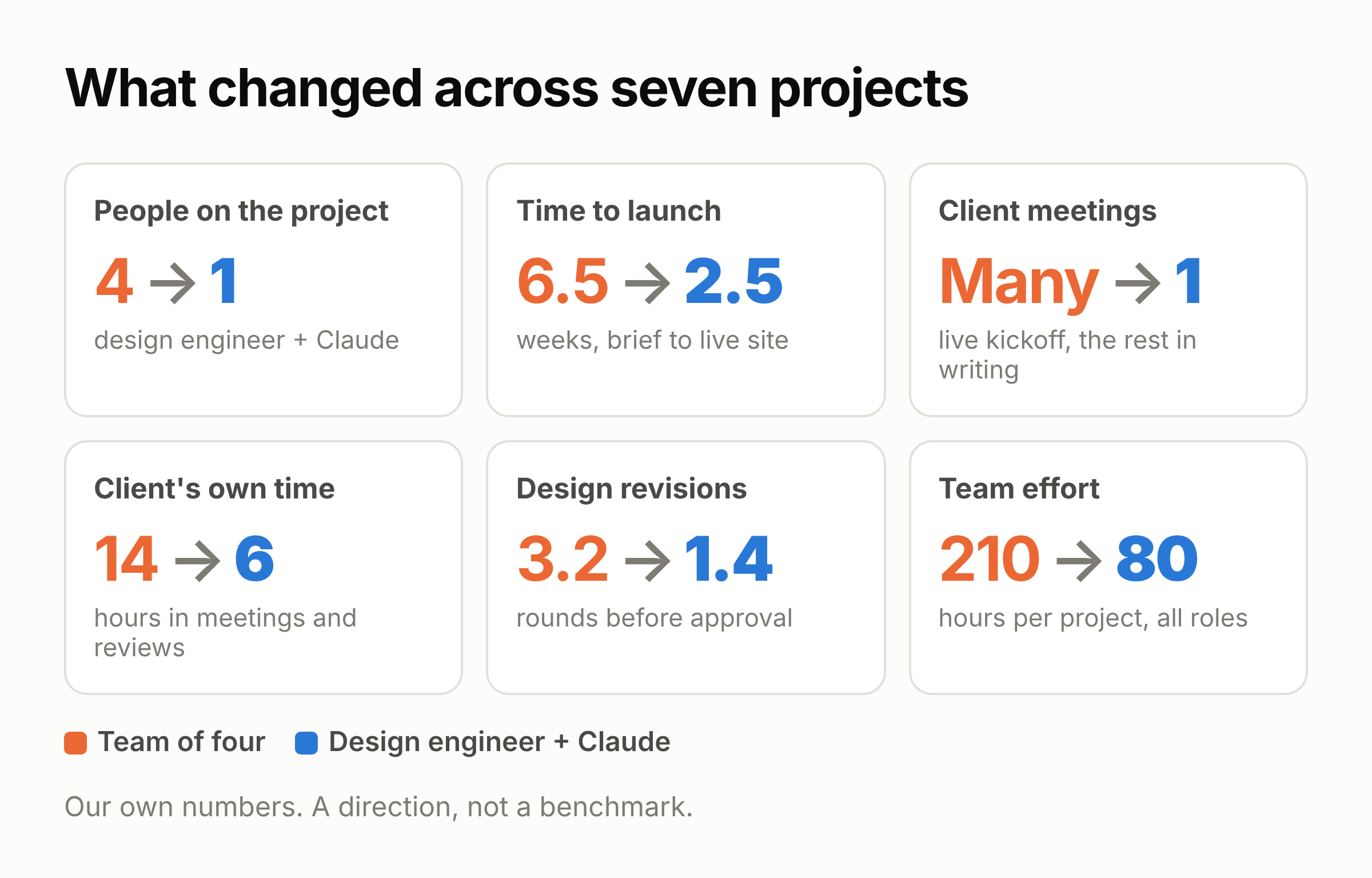
These are our own numbers across seven restaurant, shop and venue sites with booking or ordering, compared with similar projects run by a four-person team the year before. Think of them as a direction, not a benchmark.
Sites went live in 2.5 weeks instead of 6.5. The client spent about 6 hours in meetings and reviews instead of 14. Design revisions dropped from 3.2 rounds to 1.4, and the team put in about 80 hours instead of 210.
Most of the saving is not AI doing the work faster. It is coordination that no longer exists: retelling the brief, waiting for a review slot, rebuilding a design in code. The wider data points the same way. Webflow’s 2025 State of the Website survey of 500 marketing leaders found that 96% believed they could collaborate better with engineers, and 91% said the website drives more revenue than any other channel. For a restaurant, that revenue is bookings, which is why stage 3 is a real booking made on the owner’s phone.
What we learned
Keep one live meeting and make it count. The kickoff is where the whole project is decided, and everything after it is easier when the brief is clear.
Keep Figma in the loop, even when you could skip it. The designs are what the client signs and what you point to later.
And remember that AI amplifies whatever process it lands in. Google’s 2025 DORA report makes the same point about software teams. Give a design engineer a clean style kit, a clear brief and two working connections, and the speed-up is real. Give the same tools to a team that still runs a seven-step relay, and you get a faster relay with the same number of handoffs.
The client still gets a designer, a developer and someone who stays in touch from the first brief to launch. They are the same person, and they have a very capable assistant.
Further reading
Design Engineering at Vercel: what we do and how we do it: the clearest first-party definition
Design Engineering: the complete guide for 2026: skills, history, and why the handoff stops being a handoff
Figma 2025 AI report: 2,500 designers and developers on efficiency and quality
Webflow MCP server overview: pages, elements, styles, components, CMS, and the bridge app
Guide to the Figma MCP Server: write-to-canvas support by client
Design context, everywhere you build: Figma on remote MCP
Brooks’s law: why communication paths grow faster than headcount
Microsoft Work Trend Index 2023, summarised by the World Economic Forum: 31,000 people on meetings and focus time
The true cost of meetings, by the numbers: a roundup of meeting-cost research
Webflow, the 2025 State of the Website: 500 marketing leaders on sites, revenue and engineering collaboration
The 2025 DORA Report: AI as the amplifier of whatever process it lands in
We put Claude inside our design process and kept Figma on purpose: our earlier piece on the same approach at enterprise scale (link once published)